The Two-Ingredient Formula for Real Connection
About this series. In my practice, I’ve found that when people are frustrated by trying to “find the right person,” they’re actually struggling to develop an intimate connection. Connecting with another person requires two elements: curiosity and vulnerability. Fortunately, even though most of us were never really taught how to do this, connecting is a practice we can develop. Every person you sit across from is someone you can know right now, if you’re willing to allow yourself to be known. This series explores how to make a practice out of connecting with people.
Inspired by “Deep Dating: New Rules for Creating Intimacy” by the Inter Change Counseling Institute.

You have planned a first one and only date with someone new and exciting. But what next? Small talk? Nobody actually likes small talk. We endure it because it feels safer than the alternative, but very few people walk away from a date full of surface-level conversation feeling nourished. We feel vaguely tired, a little hollow, as though we went through the motions of connection without actually connecting.
And yet we keep doing it. Because what’s the alternative?
After years of thinking about intimacy (in my own life, in the therapy room, and in the relational literature I have read), I’ve come to believe that real connection between two people comes down to two things. It’s not chemistry, not compatibility, not even shared values, though those matter in their own way.
They are curiosity and vulnerability. So, that’s the formula: Curiosity + Vulnerability = Intimacy. I’ll explain what I mean.
Curiosity: Actually Wanting to Know Someone
Most of us think we’re curious about the people we date. But there’s a difference between gathering information and genuine curiosity. One is assessment. The other is the desire to know and understand. Information-gathering is what we do when we’re evaluating someone. It’s collecting data points, checking them against our criteria, and determining whether this person is worth continued investment. It looks like curiosity - it isn’t.
Genuine curiosity has a different texture. It’s less transactional and more alive. It’s the feeling of actually being interested in what’s happening inside another person - not to assess it, but just because people are fascinating. And this particular person, right in front of you, is one of them.
There’s a difference between gathering information about someone and being genuinely curious about them. One is evaluation. The other is the beginning of intimacy.
Curiosity in this sense means following the interesting thread in what someone says instead of waiting for your turn to speak. It means asking the follow-up question that goes a little deeper, rather than moving on to the next safe topic. It means letting yourself be surprised by what someone thinks, what they’ve been through, what matters to them, and what doesn’t.
And it means being curious about the interaction itself. What’s happening between you right now? What’s the quality of the connection at this moment? What’s present, and what’s getting in the way?
Researcher Arthur Aron and colleagues demonstrated this memorably in a 1997 study (Personality and Social Psychology Bulletin) in which pairs of strangers worked through a series of increasingly personal questions and then maintained eye contact for four minutes. Compared to pairs who engaged in ordinary small talk, these participants reported significantly greater feelings of closeness. Some even described leaving the lab feeling like they’d made a real friend. What Aron was capturing, in part, is the effect of mutual curiosity: both people actively interested in the other’s inner world, rather than skimming the surface.
This kind of curiosity is available in any relational context, whether you’re on a first date, deepening an existing connection with your long-term partner, or getting to know someone in a kink context where curiosity about a person’s inner world is just as important as curiosity about their desires. The form the connection takes doesn’t change what makes it real.

Vulnerability: Actually Letting Someone Know You
Vulnerability is the half that most of us find more challenging.
We’ve learned, through years of social conditioning, to be concerned with impression management. We seek to look composed when we feel like a mess. We try to perform confidence that we don’t always feel. We strive to hide the parts of ourselves we’ve been taught are too much, too weird, too broken, too different. For many people, that list has included fundamental things like who they love, how they love, or what they desire.
The cost of all that management is that we end up in proximity to people without actually being close to them. We get the form of connection without the substance. Someone can spend months with a carefully curated version of you and never actually know you.
Brené Brown, whose research on vulnerability and shame spans decades, describes in Daring Greatly (2012) how vulnerability is not weakness but “the birthplace of love, belonging, joy, courage, empathy, and creativity.” The managed, curated self we bring to early dating is, in Brown’s framing, a kind of armor - protection against the risk of being seen and found wanting. It keeps us safe. It also keeps us unknown.
Vulnerability is the practice of letting a little more of the real thing through. Incrementally sharing increasingly intimate aspects of ourselves brings richness: a small, honest thing about what you’re feeling right now, a genuine admission about what you’re hoping for in this particular interaction, or a moment of not knowing, held openly.
You can spend months with a carefully curated version of someone and never actually know them. Vulnerability is what closes that gap.
Here’s the thing about vulnerability that tends to surprise people: it’s not just about sharing your struggles or your pain, though that matters. It’s about letting yourself be seen wanting something. That’s often the part that feels most exposed: admitting that you care, that this matters to you, that you’re hoping it goes somewhere. We’d sometimes rather share our worst wounds than admit our simplest hopes.
But when you do this, when you let someone see that you’re genuinely hoping for connection, that this conversation is actually meaningful to you, something shifts. The other person feels it. And if they have any capacity for vulnerability themselves, they tend to meet you there.
Just a note about sharing your vulnerability. Be attentive not to let it all out at once, and be cautious about going too deeply too early. That’s not vulnerability, that’s flooding or trauma dumping, and it tends to overwhelm rather than connect.
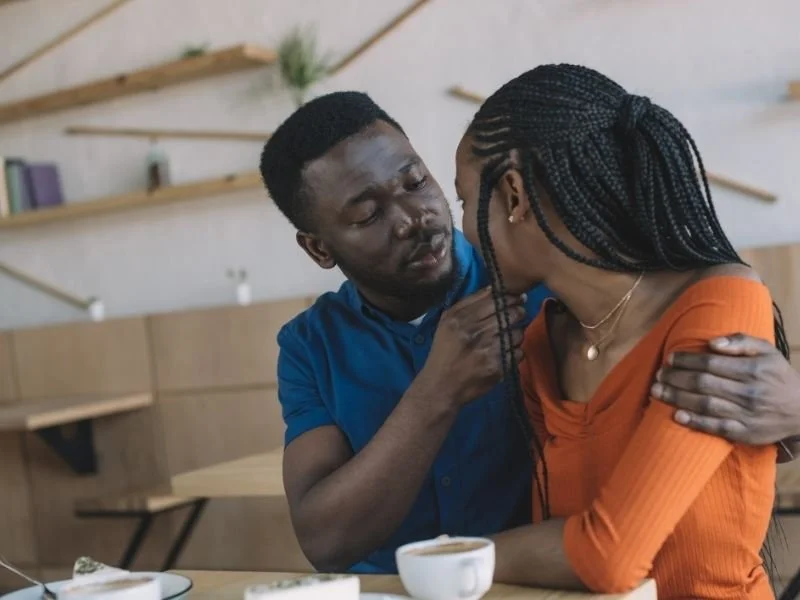
Why You Need Both Curiosity and Vulnerability
Here’s where the formula matters. Vulnerability without curiosity is just self-expression. You’re pouring yourself out, but you’re not actually making contact with the other person. It can feel cathartic for you and exhausting for them. And it can feel to the other person like you’re selfish, or not interested in who they are.
The opposite, curiosity without vulnerability, is safer, but it has its own limitations. You can be genuinely interested in someone and still stay completely hidden yourself. Some people are all attunement all the time - exquisitely attuned to their date’s experience, while offering almost nothing of their own. That’s not intimacy either. Putting all your attention on the other person keeps you invisible.
It’s the combination that creates something real. When you’re genuinely curious about the person in front of you and willing to let them be genuinely curious about you in return, when information flows in both directions, when both people are actually present - that’s when the thing we’re all really dating for starts to happen.
This combination is something I often work on with people in therapy - developing the practice of sharing while also tuning into the other person. It’s not about fixing something broken, but building a capacity that most of us were never quite taught. How to be curious about another person and vulnerable with them at the same time. How to stay open rather than managed. How to let connection happen rather than trying to engineer it.
It’s a practice. And every date, every conversation, every moment of genuine contact is a chance to develop it - whatever shape your relational life takes. Getting good at this requires trust. You’ll need to build trust in yourself and in the person you are spending time with. The next post will talk about how that’s done.
Learning to be both curious and vulnerable with the same person at the same time is something most of us find easier with a little support. If you’re interested in exploring your relational patterns in a warm, affirming space, I’d love to hear from you. I’m Dana, an Associate MFT working with individuals in person in San Francisco and via telehealth across California, and I work with people across relationship structures, orientations, and identities.