Why Are You Dating? (The Real Reason Might Surprise You)
About this series. In my practice, I’ve found that when people are frustrated by trying to “find the right person,” they’re actually struggling to develop an intimate connection. Connecting with another person requires two elements: curiosity and vulnerability. Fortunately, even though most of us were never really taught how to do this, connecting is a practice we can develop. Every person you sit across from is someone you can know right now, if you’re willing to allow yourself to be known. This series explores how to make a practice out of connecting with people.
Inspired by “Deep Dating: New Rules for Creating Intimacy” by the Inter Change Counseling Institute.
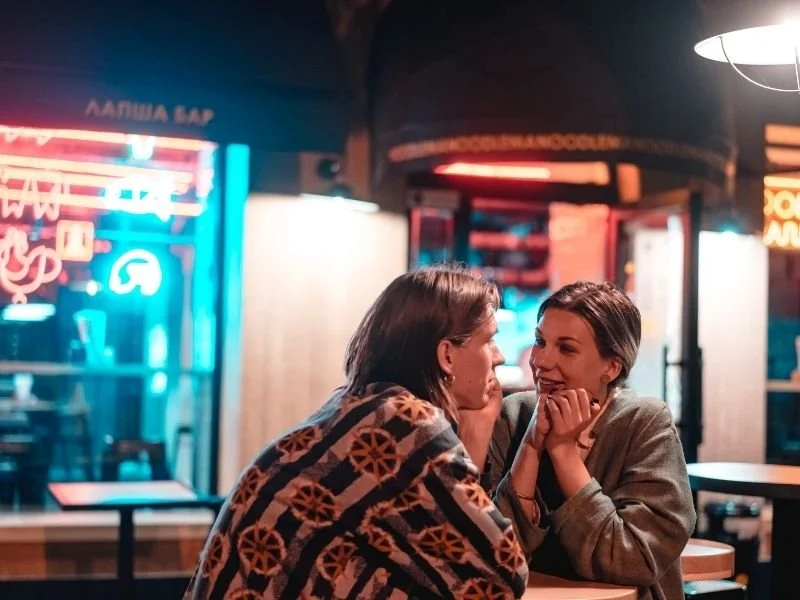
If you’ve been dating for a while, you probably have a list. Maybe it lives in your head as a rough sketch of the traits of the person you’re looking for: compatible values, a shared sense of humor, similar life goals. Or maybe your list includes features that feel harder to say out loud: someone who understands your relationship structure, someone who shares your sexual orientation, kink interests, a particular flavor of queer, or someone who gets why you have built your life the way it is.
There’s nothing wrong with knowing what you want. But here’s something I notice in my therapy practice: the checklist approach to dating makes the whole experience more exhausting, more transactional, and less alive than it should be.
So, what the heck is the alternative?
The Thing You’re Actually After
Think about the times in your life when a date or a new connection felt genuinely exciting - not because the person was objectively perfect on paper, but because something real happened between you. There was an unexpected moment of honesty. You shared a laugh that turned into something deeper. You found vulnerability that landed softly instead of awkwardly. There was a feeling, however brief, of being actually seen.
That experience of genuine contact, of feeling a little less alone, is what most of us are really after. And here’s what I find meaningful about this: it doesn’t matter whether you’re deeply monogamous and looking for your person, consensually non-monogamous and building a constellation of connections, or somewhere in the middle, still figuring out what your relational life wants to look like. The underlying need is the same. We all want to be known. We all want to feel less alone.
We think we’re dating to find our person and be done. But underneath all that strategy, we’re really chasing something much more immediate: the feeling of real contact with another person.
When I work with people who feel stuck or burned out on dating, regardless of their relationship orientation or identity, this reframe is often the most useful place to start. Not “how do I find the right person?” but “what am I actually looking for when I walk into that coffee shop, step onto that trailhead, or click into that first video call?” The answer is almost always some version of: to feel seen, to feel connected, or to feel like myself around someone else.
Why the Strategy Gets in the Way
When we date primarily to secure a particular outcome, almost everything we do becomes strategic. We manage impressions. We withhold the parts of ourselves that feel most vulnerable until we’re sure the other person is worth the risk. We test. We calculate. We perform.
Erich Fromm wrote about something like this in The Art of Loving (1956), distinguishing between a “having” orientation to love, treating a partner as something to acquire and possess, and a “being” orientation, in which love is an active practice rather than a destination. The checklist approach to dating is deeply in “having” mode. It mistakes accumulation for connection.
I see this pattern a lot with people who describe their dates as feeling flat, even when the other person seemed genuinely great. When I ask whether they were actually present during the date, there’s often a pause. They were so busy evaluating and being evaluated that they weren’t really there.
What Becomes Possible Instead
When you shift the goal from “get the outcome” to “make real contact with this person right now,” something loosens. You stop auditioning and start actually showing up. You get curious about the person instead of assessing them. You take small risks: Say something true, ask something real, let yourself be a little moved by what they share.
This works regardless of what you desire from your relational life. The capacity for making genuine connection is a practice you can develop. Similar to meditation, you can develop and deepen this practice through thoughtful engagement and iteration. It might feel weird or uncomfortable at first, but as you practice, it will become more natural and fulfilling.

A New Way to Think About Dating
Imagine that you have set up a date with someone you are very curious about. But you are aware that they are looking for a certain type of person to be with, that they have a set of expectations that must be met before you can hope for another date. During the date, you are cautious about going too far outside the bounds of these expectations, and you constantly monitor their responses to your actions, adjusting your behavior to match as closely as possible what you think they are looking for.
While your attention is on your own self-evaluation, you miss the subtle cues that signal an opportunity to ask questions that would allow you to get to know them. You miss opportunities to open yourself up and to satisfy their curiosity about you. Because you are thinking about who you need to be in a hypothetical relationship with this person, you miss the opportunity to connect and build intimacy right now.
Even if you were successful at portraying yourself as the person who deserves a second date, would you consider that this first date was successful? Would you think that you’d had fun? Would you come away with a real sense of having built a connection with this enticing person?
And this is important: so much of what we do on dates isn’t actually for the date we’re on. It’s for some imagined future version of the connection. Some of us are establishing ourselves as low-maintenance. Or, we’re signaling our values without coming on too strong. Or, we’re hinting at what we’re looking for - a long-term partner, a secondary, a play partner, a friend who might become more - while carefully not showing our hand.
We’re building a foundation, which sounds reasonable until you realize that all that foundation-building is happening rather than the actual connection we came for.
The One and Only Date
And now, instead, try this thought experiment:
You’re about to meet someone. You think you might like them. There’s something about them you’re genuinely curious about. But for reasons you can’t fully explain, you know this will be the only time you ever see them. No second date, no possibility of something developing over time. Just this one afternoon, this one conversation.
How would you show up?
My guess is - differently - more present, less calculating. You’d show up less worried about making a good impression for the future, because there is no future to manage. You’d be more willing to say something true, ask something real, follow your actual curiosity rather than the script. You’d stop laying groundwork and start actually being there.
When we’re busy laying groundwork for a future that may never come, we miss the present moment that’s actually here.
The “only date” idea isn’t about ruling out future meetings or refusing to let things develop. It’s an invitation to treat each encounter as complete in itself. To ask not “could this become something?” but “what’s possible between us right now, in this conversation?”
This applies whether you’re someone who dates with deep intentionality toward a long-term partnership, someone who holds connections more fluidly, or someone navigating multiple relationships at once. Whatever the structure, the moments of real contact are what make it worth it. And those moments are happening - or not - right now.

What Steals Us From the Present
A few things reliably pull us out of presence. Fear of rejection is a big one. It turns our attention inward, toward self-monitoring, toward the constant background noise of “how am I coming across?” That noise makes genuine contact nearly impossible.
Then there’s what I’d call premature categorization. This is the mental act of sorting someone into a role before we actually know them. Is this person serious enough for me? Too serious? Will I get bored by them? Do they seem likely to anxiously attach? Are they someone we will want to introduce to our parents? And when we file someone into categories, we are then relating to a projection rather than the actual human in front of us.
I work with people on this stuff in therapy, because these behaviors rarely stay confined to dating. The same habits that make us guarded on a first date tend to show up in long-term relationships, in friendships, with colleagues, and even within our families of origin. They show up in all the places we most want to feel close, but somehow keep our distance.
The Practice of Being Here
This “only date” approach is a shift in intention. It means arriving and asking: What can I offer this person right now? What am I genuinely curious about them? What would it mean to let myself be a little changed by this conversation?
That last one is underrated. Real connection requires genuine openness to being affected, to having your thinking shifted, your emotions moved, and your assumptions gently upended. When we’re in evaluation mode, we’re protecting ourselves from that kind of influence. When we’re actually present, we’re not.
I absolutely understand that the uncertainty of that is uncomfortable. You don’t know where it will go. You don’t know what version of yourself will show up. But that uncertainty is also exactly where the interesting stuff lives. It is where delight, excitement, and intensity emerge.
So, if you have a date planned with someone, specifically a first date, consider offering this concept to them. It works better if you are both on board with this approach. Imagine you’ve been texting with someone and you’ve agreed to meet for a walk, or coffee, or a fancy craft cocktail. Consider sending them this:
“Hey, I don’t know about you, but I’ve often found first dates kinda suck. There’s too much evaluating the other person against some invisible checklist instead of really sinking into having an experience with them. I’d like to propose that we consider this date our one and only date. We can be present with each other without worrying about where it’s going or whether we are good for each other. Then, afterward, if we’ve both had a great time, we can consider whether we’d like to have another one and only date. But only afterward.”
And if this person is curious about this idea and wants to know more, you can send them this post.
You may be wondering how to let go of the checklist and make a real connection, forming intimacy. That’s what I’ll talk about in my next post.
If you find yourself going through the motions rather than actually being present, that pattern is usually worth getting curious about. I’m Dana, an Associate Marriage and Family Therapist working with individuals and couples navigating relationships and intimacy, in person in San Francisco and via telehealth across California. I work with folks across a wide range of relationship structures and identities. If this resonates and you’d like to explore it further, I’d welcome the conversation.